Art in Everything: From Bruegel to Web applications
- Topic
- Reflections
- By
- Petro Lashyn
- Published
- Reading
- 4 min
Why creativity is everywhere — if we choose to see it. In art, in programming code, in our everyday actions.

It is an undeniable fact that Homo Sapiens have engaged in creativity from ancient times to the present. After all, according to the Bible and the Quran, creation itself is the fundamental act that brought the world into being. Creation is both the cause and the prerequisite.
"Ever-newer waters flow on those who step into the same rivers," said Heraclitus long ago. In this statement, "waters" can be interpreted as the endless and ceaseless generations of people, while "rivers" symbolize the universal essence that unites all who have lived, live now, and will live on Earth. One of the key components of this universal essence is humanity's ability to create and interpret creativity.
A reader of Meditations by Marcus Aurelius is likely to find more thoughts resonating with contemporary times than in the New York Times bestsellers of 2024. The paintings of Pieter Bruegel the Elder evoke emotions no less than those of Banksy. Here and now, in the present, we have Banksy, Stromae, Billie Eilish, and the films of David Lynch—none of which existed in Bruegel's time. The Flemish school of painting, to which Bruegel belonged, did not exist in the days of Marcus Aurelius. And in Heraclitus's lifetime, neither Aurelius nor the Roman Empire had yet emerged. This means that the variety of creative expressions known to humanity accumulates over time, while the universal capacity to understand and interpret creativity not only remains but also expands.
Yet art has always hidden itself not only in great books and wealthy museums. It is no longer solely "high" or elitist. It can be found everywhere—in the design of tableware on store shelves, in SpaceX spacecraft and Japanese automobiles, in the kit design of Manchester City for the 2024/25 season, in the latest models of Hoka running shoes. It exists in well-executed work—whatever that work may be—in facade renovations, in floral arrangements, in writing code, or in cleaning public restrooms (a nod to Perfect Days). It is present in Chinese souvenirs sold at Istanbul's Grand Bazaar and in authentic embroidered shirts at the Kosiv market. It is in the things people craft with their hands—whether a knitted sweater, a built house, a restored chair, or a necklace of agate. It is in the photographs filling Google and Meta data centers.
Creativity manifests itself in poetry, paintings, music, and the reflections of modern minds. Of course, not everything deserves a place in a museum or to be immortalized on a vinyl record. But even Duchamp's urinal once found its place in world culture. Every act of creation has the right to be named and manifested—just as it has the right to be ignored or remain unexpressed.
In the visions of a possible happy future painted by futurists, a common theme emerges: humanity will dedicate most of its time to creativity, education, and science rather than to securing comfortable survival and an illusion of safety. There is an undeniable understanding that the ability and opportunity to create—without being distracted by financial pyramids, war, or mortgage payments—will be one of the greatest privileges of the future human.
In his seminal book Concerning the Spiritual in Art, Wassily Kandinsky wrote: "To harmonize the whole—that is the task of art." The whole world is a single entity, and everything around us is subject to harmonization. The further we go, the more complex it becomes, because the number of elements increases. Yet it is within this mosaic that the true imprint of humanity is found.
And artificial intelligence will not take away humanity's ability to create and interpret creativity. Because, as it seems, this is a gift granted to humans by the very force that once, through an act of creation, made them in its own image.
And here are some beautiful paintings which I've enjoyed in my recent trip to Vienna.
- Pieter Bruegel the Elder - The Hunters in the Snow (1565)
Kunsthistorisches Museum

- Egon Schiele - Self-portrait with stripped shirt (1910)
Leopold Museum

- Max Pechstein - Young Lady with Feather Hat (1910)
Leopold Museum
And the beautiful quote from Egon Schiele:
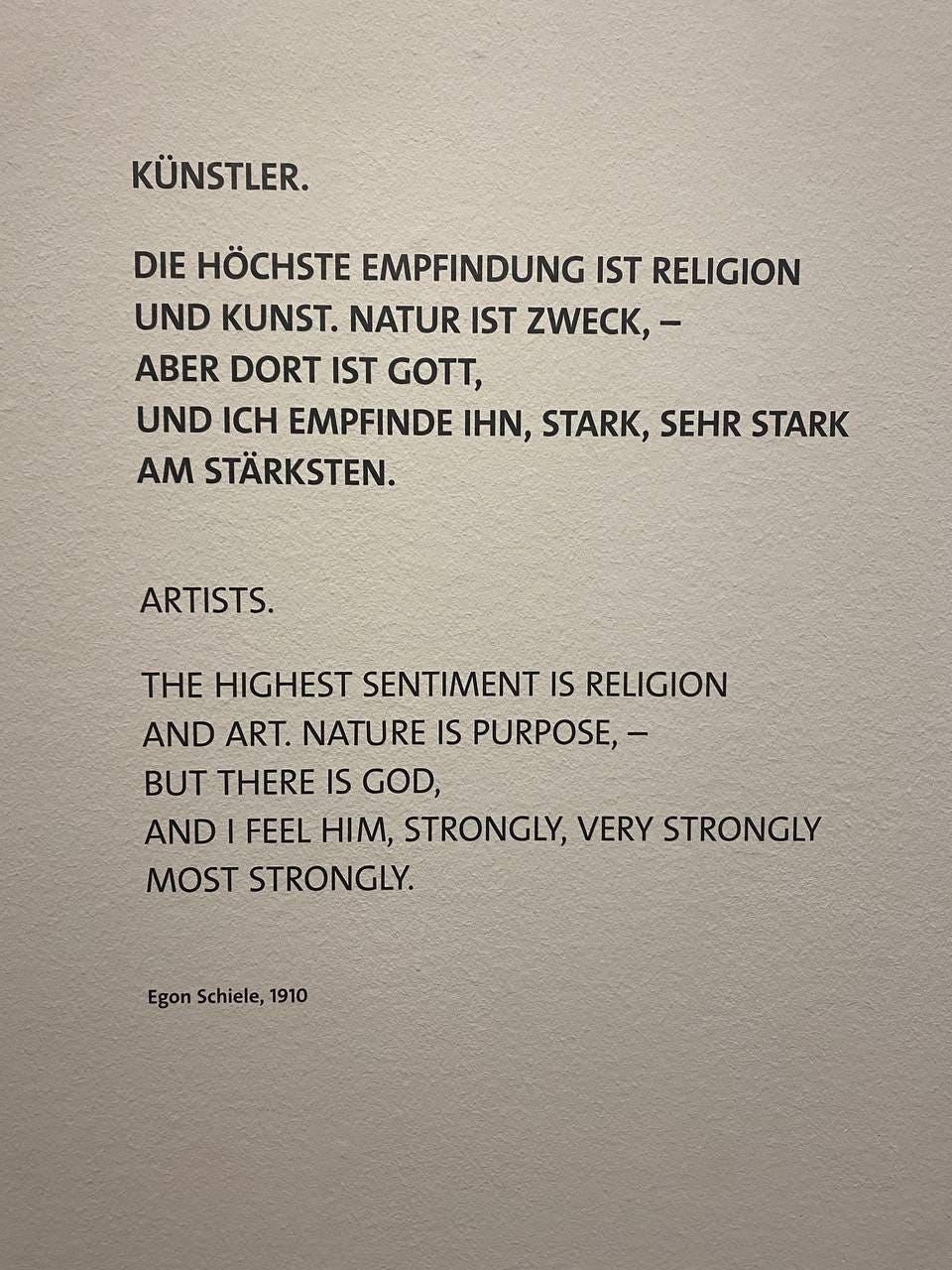
Photos by the author, taken during a trip to Vienna.
Thanks for reading.